


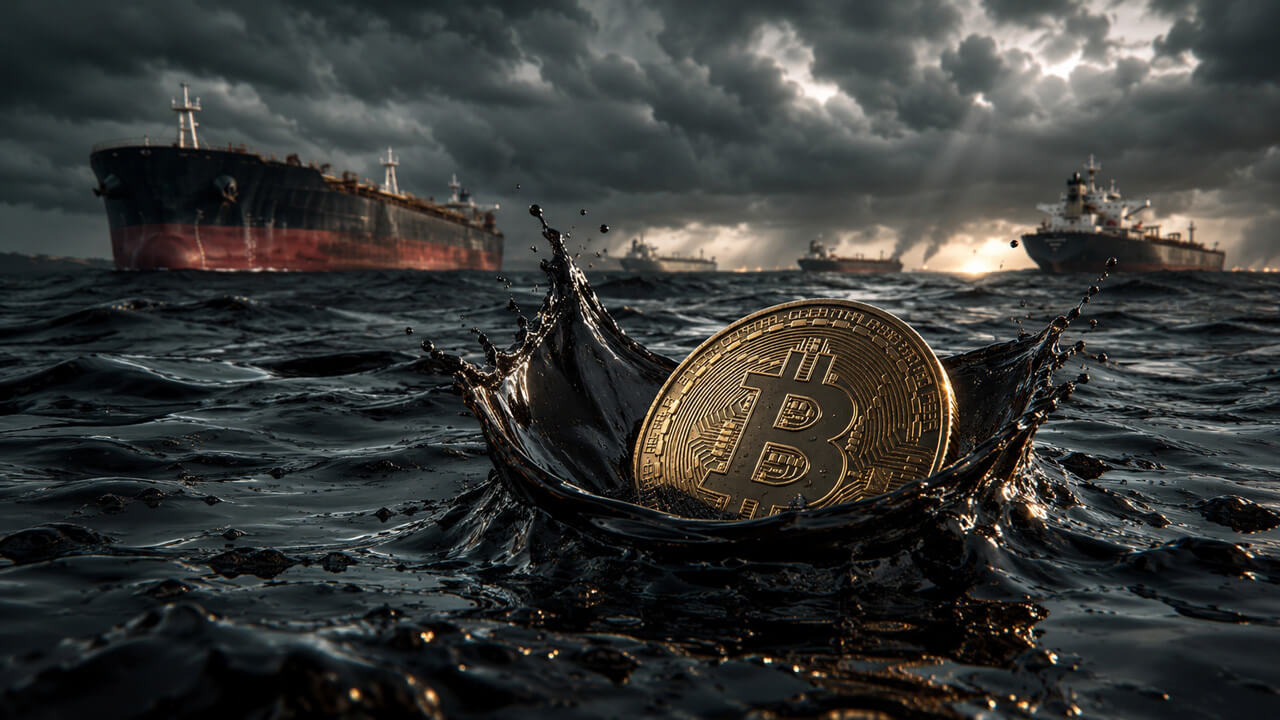


A prominent figure from the Washington foreign-policy establishment has said openly what markets have been pricing in fragments: the United States has likely suffered a strategic defeat in Iran, and the failure runs through the Strait of Hormuz. Accepting this premise would introduce a new macro risk for Bitcoin.
The warning comes from an article by Robert Kagan in The Atlantic. Kagan sits inside the interventionist wing of U.S. foreign policy, the Project for the New American Century, and the broader doctrine that treated American military dominance as the organizing principle of the post-Cold War order.
Kagan is not a fringe dissenter warning about imperial overreach from the outside. He helped define the intellectual framework behind the post-Cold War expansion of U.S. power.
His work shaped the worldview that American military primacy could stabilize trade routes, contain adversaries, and preserve the liberal international order through sustained forward projection. That framework influenced both Republican and Democratic administrations across Iraq, Afghanistan, NATO expansion, and the broader interventionist consensus that dominated Washington for decades.
When a figure within that architecture argues that the United States has likely suffered a strategic defeat in Iran, markets must treat it differently from routine geopolitical commentary.
Thus, his position comes from inside the intellectual infrastructure that helped build the policy architecture now under stress.
Kagan argues that Vietnam and Afghanistan were costly but survivable for the U.S. position in the world.
Iran is different because the loss sits inside a live energy chokepoint, inside the Gulf security architecture, and inside the credibility of U.S. military deterrence.
The market question follows directly from that strategic diagnosis.
If Washington’s own think-tank class now believes Iran has imposed a new operating reality in Hormuz, the downstream issue is whether oil, LNG, shipping, insurance, inflation expectations, Treasury yields, Fed policy, and Bitcoin begin trading around a world where U.S. maritime guarantees carry a measurable discount.

Hormuz has become the transmission channel from military failure to inflation risk
The Strait of Hormuz is the mechanism that turns a regional defeat into a global macro variable.
The passage handles roughly a fifth of global oil flows and remains central to Gulf LNG traffic.
Once Iran establishes even partial discretionary control over passage, the market prices Hormuz as a conditional route governed by military risk, diplomatic side deals, insurance costs, naval credibility, and Iranian tolerance.
That is the real content of Kagan’s argument.
He reportedly frames Iran’s leverage over Hormuz as a durable consequence rather than a temporary disruption.
Entrepreneur Arnaud Bertrand extends that point by arguing that “freedom of navigation” has been inverted into a permission-based regime.
The distinction is crucial. A closure is an event. A permission regime is a new pricing layer.
It can function without daily explosions, seizures, or a full blockade.
It requires sufficient uncertainty to force every cargo owner, insurer, refiner, and state buyer to ask whether transit remains automatic. Recent reporting already points in that direction.
AP reported that the U.S. military moved to guide stranded ships through the strait while Iran-linked pressure tested the fragile ceasefire. The Financial Times reported that a Qatari LNG shipment cleared Hormuz after Pakistan-Iran talks, a detail that shows the new order in miniature.
Cargo moves, while movement increasingly depends on mediation. That is a very different market signal from open passage under U.S. naval dominance.
The inflation channel begins with energy and then moves through the rest of the supply system. Higher crude prices lift gasoline and diesel. LNG disruption feeds into electricity costs and industrial input prices, especially in Europe and Asia.
Shipping delays increase working capital needs. War-risk premiums raise delivered costs. Inventories become more valuable, which encourages hoarding by states and firms.
Each layer adds friction to the global supply chain.
A 1973-style embargo is no longer required to affect policy. The Fed reacts to realized inflation, inflation expectations, financial conditions, and the credibility of its own path.
If Hormuz risk becomes persistent, energy prices can remain high enough to slow disinflation without delivering a classic demand boom.
That is the worst configuration for central banks: weaker growth with sticky headline pressure and renewed pass-through risk.
It narrows the room for rate cuts even as households absorb higher fuel, utility, and transport costs.
The White House can call that victory. Bond markets will call it term premium.
Rates become harder to cut when the security guarantee itself carries a Bitcoin macro risk premium
The rates implications are larger than one oil spike.
A war that reveals depleted U.S. weapons stocks, a weaker naval deterrent, and Gulf-state hedging changes how markets think about U.S. power as a macro stabilizer.
Kagan’s reported claim that weeks of war reduced American weapons stocks to perilously low levels is especially important because it moves the issue from battlefield optics to industrial capacity.
The problem becomes inventory, production cycles, fiscal demand, and alliance confidence. That feeds directly into the Treasury market.
A U.S. security guarantee has historically operated as a deflationary asset in the global system. It reduced the perceived need for regional arms races, secured energy lanes, and allowed Gulf producers to operate inside a U.S.-centered order.
When that guarantee weakens, several consequences follow. Gulf states diversify security relationships. Energy buyers build redundancy. Shipping routes become more expensive. Defense budgets rise. Fiscal pressure increases. Investors demand compensation for a wider distribution of outcomes.
This is where Bertrand’s take is strongest. He sees Kagan’s essay as an establishment acknowledgment that the old equation has broken. The U.S. fought to demonstrate control and instead exposed the limits of control.
Gulf states now have to weigh a distant superpower against a regional power that can impose costs at the point of transit. East Asian and European allies have to ask whether U.S. staying power remains adequate in a higher-intensity conflict.
China and Russia have to assess whether their critique of American overreach has gained operational evidence.
That is also why a comparison to Suez is more useful than Vietnam. Vietnam damaged U.S. prestige but left the core financial and energy architecture of the American-led system intact. Suez exposed the limits of British and French imperial power in a way that accelerated recognition of a new hierarchy.
If Hormuz has become the place where American naval dominance no longer guarantees open passage, the comparison becomes uncomfortable for Washington.
Markets will express that shift across oil curves, shipping rates, gold, defense equities, inflation breakevens, long-end yields, the dollar, and eventually Bitcoin.
The timing is uneven. Oil and shipping react first. Rates then absorb the inflation and fiscal implications.
Bitcoin usually reacts later, once the market begins translating geopolitical stress into questions about monetary credibility, sovereign balance sheets, and the value of politically neutral settlement assets.
Bitcoin macro test is liquidity, while its larger test is credibility
The near-term risk is straightforward.
A Hormuz premium can slow the Fed’s easing path. A slower easing path keeps real yields tighter than risk assets would prefer. That can pressure Bitcoin initially, especially if liquidity expectations are repriced downward.
The medium-term risk points in the opposite direction.
If the U.S. is forced into higher defense spending, higher energy support, larger deficits, and more politically constrained monetary policy, Bitcoin’s sovereign-risk hedge begins to regain relevance. Bitcoin rarely leads the first phase of a geopolitical macro shock.
The first response usually belongs to oil, gold, the dollar, and front-end rate expectations.
Bitcoin enters the frame when the shock shifts from energy pricing to institutional credibility. That distinction is essential. A pure oil shock can hurt Bitcoin if it pushes yields higher and drains liquidity from speculative assets.
A geopolitical credibility shock can help Bitcoin if it weakens confidence in the fiscal and monetary order that underwrites fiat stability.
The Iran conflict now sits between those two regimes.
PolitiFact’s review of Trump’s victory claims pointed to the unresolved structure beneath the political language: Iran remained in control domestically, retained leverage over Hormuz, and preserved key strategic capabilities. Al Jazeera’s ceasefire analysis similarly showed that both sides claimed success while the underlying concessions left the maritime question unresolved.
The important point for markets is that ambiguity itself has value.
If Iran can extract concessions, delay transit, force mediation, or selectively permit passage, then the strait has become an instrument of state power rather than a neutral artery.
For Bitcoin, the base case is a two-stage sequence.
First comes volatility. Higher oil, higher breakevens, delayed rate cuts, and stronger dollar demand can pressure crypto liquidity.
That phase is mechanical. It reflects funding costs and risk appetite.
The second stage begins if the conflict confirms a broader perception that U.S. power can no longer suppress geopolitical risk at the system level.
That phase is structural. It speaks to reserve diversification, censorship resistance, capital mobility, and distrust of state-managed monetary outcomes.
The next macro test for Bitcoin is whether markets price a permanent Hormuz discount into U.S. power
The strongest Bitcoin argument does not require an immediate flight from Treasury markets or a sudden abandonment of the dollar.
It requires a gradual rise in the cost of trusting the old system. The U.S. can still borrow. The dollar can still rally in stress. Treasuries can still function as collateral.
Yet each new shock can force investors to hold a larger allocation to assets outside the state balance-sheet complex.
Gold is the traditional expression. Bitcoin is the digital expression. The key threshold is the Fed.
If Hormuz pressure keeps inflation sticky while growth softens, the central bank faces a narrower policy corridor.
Cut too soon, and energy inflation risks bleeding into expectations.
Stay tight too long, and the economy absorbs a geopolitical tax through credit, consumption, and investment.
Either path can strengthen Bitcoin’s longer-term thesis. One path points toward eventual liquidity rescue. The other points toward sovereign stress and fiscal dominance.
That is why Kagan’s Atlantic essay and Bertrand’s response should be treated as a macro signal, rather than only as a foreign-policy dispute.
The claim that America has been checkmated in Iran is a claim about control.
Control over escalation. Control over shipping lanes. Control over allies. Control over energy prices. Control over inflation. Control over the policy path.
Once that control is questioned by the very institutions built to defend it, markets have to price the loss in layers.
Oil prices the chokepoint. Rates price the inflation and fiscal burden.
Bitcoin prices the credibility gap that remains after the official victory language runs out.
