The first flat I occupied after graduating from college remains etched in my memory. The kitchen was so diminutive that it was impossible to pass by if the refrigerator door were ajar. Cooking initially appeared to be an aggravating experience rather than a soothing one. I was unable to locate the necessary ingredients, and the cleanup process was arduous. Additionally, I frequently collided with objects. You are not alone if you have ever experienced this emotion. A tiny kitchen can appear cluttered, despite being technically clean. The primary reason is straightforward: the space is not conducive to your needs. The absence of organisation in a kitchen results in a sluggish and stressful cooking process, as each step necessitates additional effort. The good news is that a larger kitchen is not necessary to prepare superior meals. A more intelligent layout and improved storage practices are all that is required. The primary objective of organising a compact kitchen to optimise the cooking process is tomake each movemente more effortless and organic.
Comprehending the Concept of Cooking Flow
The term “cooking flow” refers to the seamless transition from one stage to another, without the loss of energy or time. Consider the manner in which chefs operate in professional facilities. Ingredients are prepared in a logical order, instruments are easily accessible, and everything is within reach. Even in a small kitchen, it is possible to replicate the same experience at home. Observe your physical movements while preparing food. Do you frequently traverse the room in search of fundamental ingredients? Do you have to access multiple drawers in order to locate the appropriate utensil? The cumulative effect of these minor interruptions is that cooking appears to be more difficult than it should be. Meals become more pleasant and expedited when your kitchen is designed to accommodate your cooking style. Rather than resisting your environment, you begin to collaborate with it.
Decluttering Before Organizing Anything
Decluttering is the most effective measure to take before purchasing containers or rearranging shelving. Small kitchens cannot accommodate items that people use infrequently. Upon organising my kitchen, I discovered three spatulas, five chipped cups, and a pasta maker that I had only used once in the past two years. Storing items that are infrequently used in a small kitchen is akin to attempting to store winter coats in a suitcase that is used on a daily basis. Be forthright with yourself about the items you actually use. A device likely does not belong in your primary culinary area if you have not used it in the past year. The immediate creation of breathing space is facilitated by the elimination of duplicates and unnecessary instruments. This single action can revolutionise the ambiance and functionality of your kitchen.
Setting Up Specific Cooking Areas
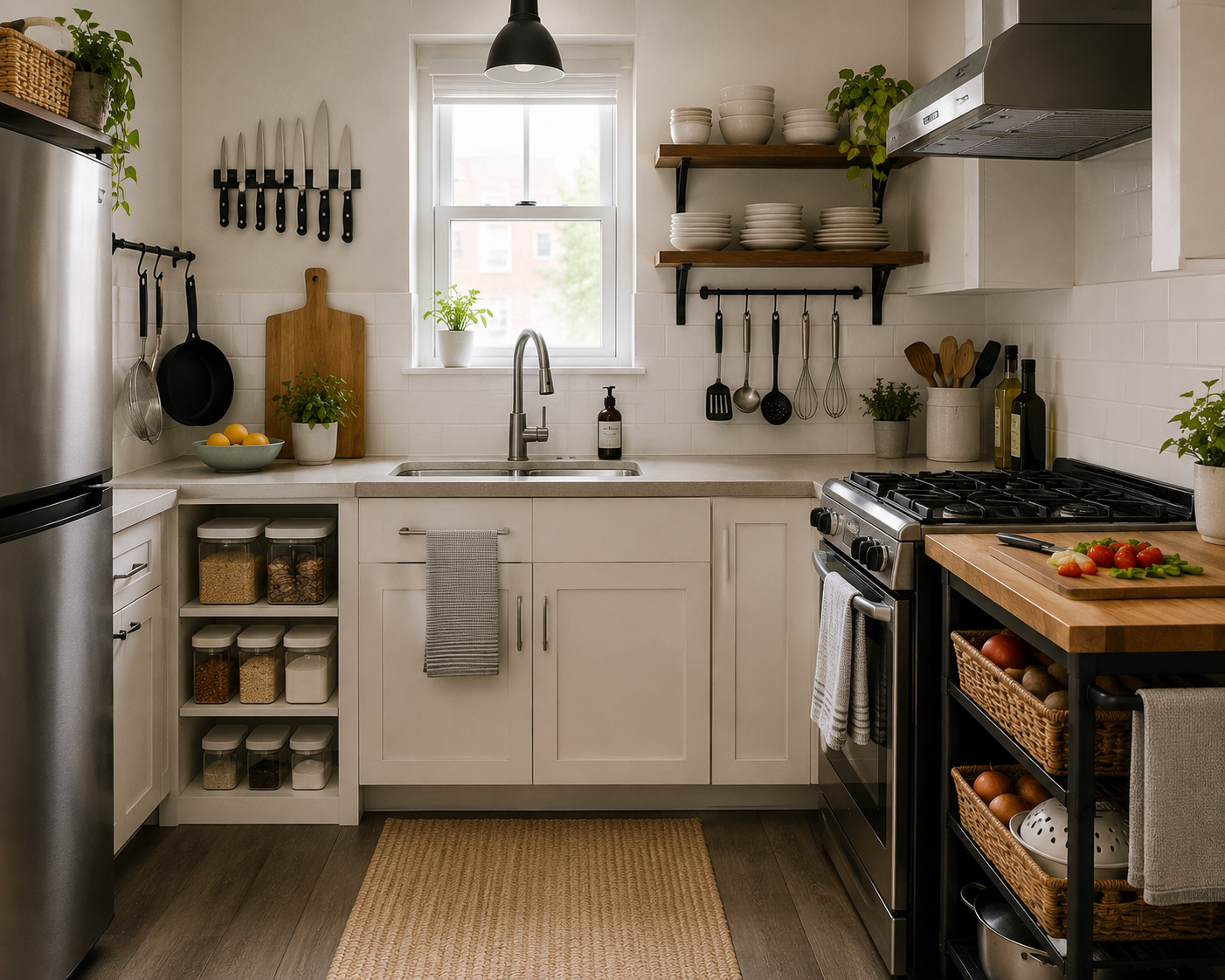
Dividing your kitchen into zones is one of the most significant enhancements you can implement. Certain duties naturally suit specific areas of even the smallest kitchen. Your stove, pots, pans, oils and seasonings should comprise the culinary zone. Cutting boards, knives, mixing bowls, and measuring instruments should comprise the prep zone. Dish soap, sponges, and trash sacks should be included in the cleaning zone. Cooking is expedited and simplified when all necessary components are located in the same vicinity. You cease to traverse the kitchen in a circular motion and commence working in a natural cadence. This straightforward adjustment can result in a diminutive kitchen that appears to operate with surprising efficiency.
Maximising Vertical Space
Vertical stowage is a more prevalent issue in small kitchens than floor space. Your kitchen’s walls are brimming with untapped potential. Installing wall-mounted racks or shelving can significantly alter the functionality of your kitchen. Hanging utensils near the stove ensures that they are readily accessible during the culinary process. Spices are stored on wall shelving, which frees up valuable counter space. Even the interior of cabinet doors can accommodate tiny racks for cleaning supplies or lids. You will become aware of the vast amount of unutilised space that surrounds you once you begin to think vertically. Vertical storage maintains a clean countertop, which enhances the efficiency of cooking and creates the illusion of a larger kitchen.
Time-Saving Smart Cabinet Organization
Cabinets frequently become disorganised due to their depth and difficulty in visibility. Items vanish from the cabinet’s rear. In order to resolve this issue, it is important to consider accessibility and visibility. Arrange frequently used items at the front of the shelf, while those that are infrequently used should be placed at the back or on higher shelves. Arrange items that are similar in order to ensure that you are aware of their location. By organising your cabinets in a logical manner, you can eliminate the need to spend time investigating. Cooking becomes more pleasurable due to the fact that everything is easily accessible and predictable. It is a minor adjustment that has a significant daily influence.
Maintaining the Functionality and Clarity of Countertops
In a compact kitchen, it is imperative to have clear countertops. Cluttered counters lead to a lack of valuable prep space and a feeling of crampedness during cooking. Items that are utilised on a daily basis, such as a knife block, coffee maker, or teapot, should be stored on the counter. All other items should be stored in a cabinet or cupboard. I observed that the culinary process was more tranquil and less disorderly once my counters were cleared. A tidy workspace facilitates the process of chopping vegetables, mixing ingredients, and moving around in a comfortable manner. Additionally, it expedites the cleansing process, which motivates you to maintain a clean environment.
Refrigerator Organization for Maximum Efficiency
The preparation process is significantly influenced by the refrigerator. The time spent seeking ingredients or discovering expired food is wasted when it is disorganised. Begin the process of organising products that are similar. Ensure that frequently used ingredients are stored at eye level. Be sure to store any remains in a visible location to prevent them from being overlooked. Meal preparation is expedited by a well-organised refrigerator, as it is immediately apparent what is in stock. Additionally, it simplifies grocery purchasing by making it possible to promptly determine which items are in short supply.
Creating Daily Routines That Maintain Kitchen Organization
Organisation is not a one-time endeavour. The genuine magic occurs when you establish daily behaviours that sustain the system. One of the most potent behaviours you can cultivate is the act of cleaning as you cook. Placing items back in their designated locations requires only a few seconds, yet it prevents the accumulation of debris. The kitchen is prepared for the subsequent meal by wiping the counters at the end of the day. Your kitchen maintains its organisation effortlessly when these minor habits become habitual. You maintain order organically, rather than engaging in extensive cleaning sessions.
Learning to Adjust Your Kitchen Over Time
You will evolve in your culinary preferences, and your kitchen should adapt accordingly. Perhaps you begin to bake more frequently or develop a passion for meal preparation. Be mindful of any discomfort you may experience and make necessary adjustments to your configuration. Flexibility is the hallmark of organisation; it is not about perfection. The most exceptional kitchens are those that develop in tandem with their proprietors. You can ensure that your kitchen operates efficiently for years to come by maintaining awareness of your routines and making incremental improvements over time.
In conclusion,
It is not necessary to purchase costly storage tools or yearn for a larger kitchen in order to optimise the cooking process in a compact kitchen. It is a matter of comprehending your cooking practices and constructing your kitchen accordingly. Even the smallest kitchen can be transformed into a space that is both efficient and pleasurable by decluttering, creating zones, utilising vertical storage, and adhering to basic daily habits. When all items have a designated location and each action is logical, cooking becomes more creative and less stressful. A thoughtful approach and a little consistency can transform your small kitchen into one of the most functional spaces in your home.
FAQs
1. How frequently should I reorganise my compact kitchen?
It is advisable to evaluate your kitchen every three to six months. Small adjustments can help maintain the efficiency of your kitchen, as your cooking practices may evolve.
2. What is the most common error that individuals make when utilising limited kitchens?
The most prevalent error is the accumulation of an excessive number of items. The key to maintaining efficiency and space is to declutter on a regular basis.
3. How can I increase the amount of counter space in a compact kitchen?
Utilise vertical storage, wall shelves, and cabinet organisers to relocate items from the counter and create more prep space.
4. Is it essential to acquire specialised stowage products?
It is not always the case. Decluttering and logically rearranging items, rather than purchasing new products, is the source of numerous organisational enhancements.
5. How can I ensure that my kitchen remains organised for an extended period of time?
Establish daily routines, such as returning items to their designated locations and cleansing as you cook. The system functions as a result of consistency.
Hannah is a home and kitchen writer who focuses on practical cooking, meal prep, food storage, appliance care, and everyday kitchen organization. She enjoys sharing realistic tips that help make busy home routines feel simpler and less stressful. Through experience-based articles and easy-to-follow advice, Hannah aims to help readers save time, reduce food waste, organize their kitchens more efficiently, and feel more confident managing daily cooking and household tasks.