
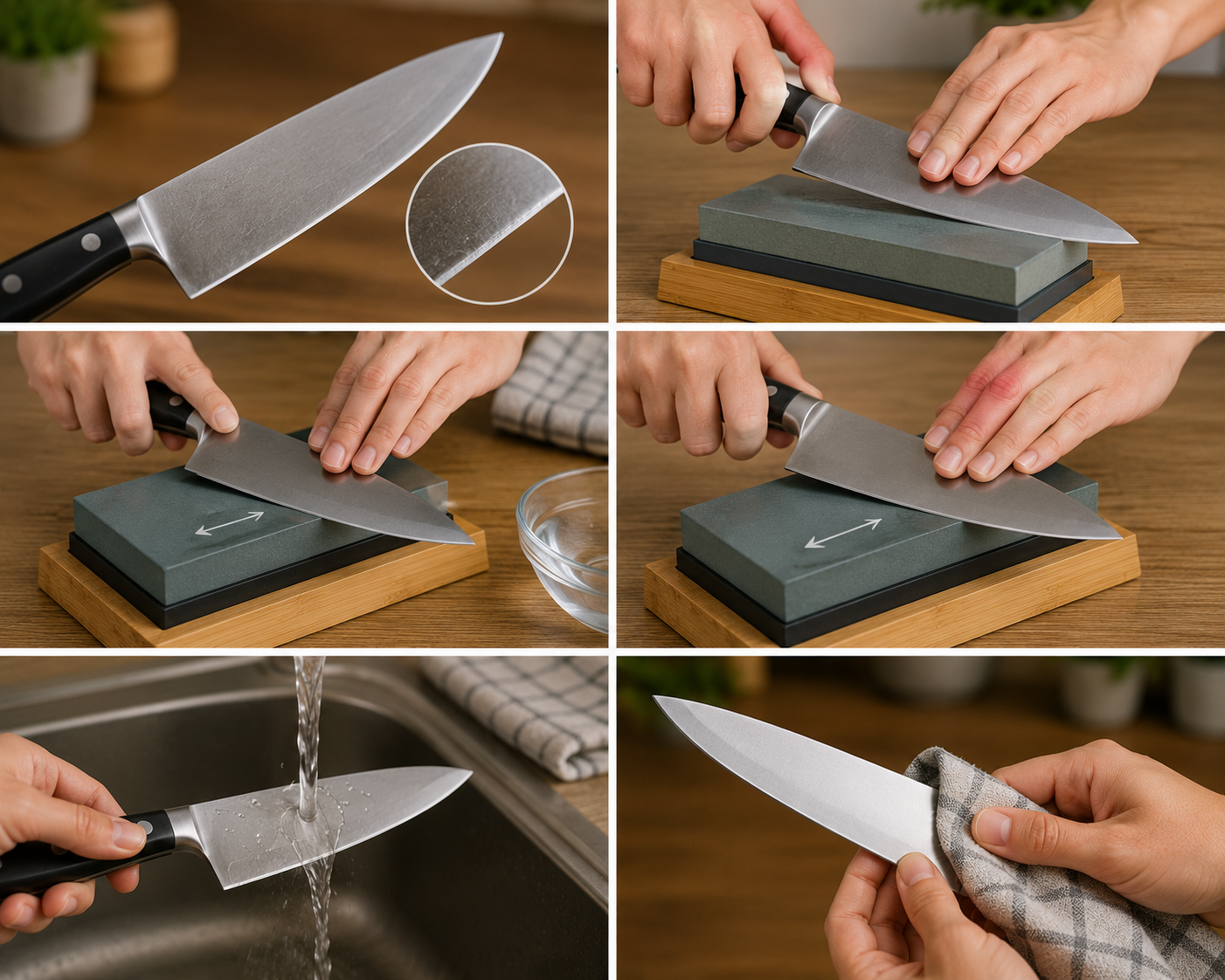
Sharp kitchen knives are indispensable in every household. Whether you cook daily or only on weekends, you probably use your knives more often than you think. But even the best knives become dull over time. When the blade comes into contact with food, cutting boards, or moisture in the air, the thin cutting edge will slowly bend, chip, or wear down. Many beginners think that knives last for years, but in reality, daily cooking accelerates this process. Cutting hard vegetables, bones, or frozen foods speeds the deterioration up.
A dull knife not only reduces cooking efficiency but also makes cooking more strenuous and less enjoyable. When cutting tomatoes, onions, or meat, you have to press hard, causing the knife to slip more easily and resulting in uneven cuts. The excellent news is that you don’t need expensive tools or professional services to sharpen your knives. With a few simple methods and a little patience, you can sharpen your knives at home and give them a new lease on life.
Why Learning Knife Sharpening at Home Is Important
People often mistakenly think that sharpening knives is difficult or that only chefs can do it. However, sharpening knives at home is beneficial, time-saving, and effortless. Instead of buying new knives or paying someone to sharpen them, you can learn a skill that will benefit you for a lifetime.
By sharpening knives at home, you prevent them from becoming dull. A knife that is sharpened regularly lasts longer than a knife that has been neglected for years. Consequently, your knives last longer and perform optimally every time you cook. In addition, the act of maintaining kitchen utensils can also be enjoyable. Sharpening your knives can boost your self-confidence and deepen your love of cooking. It becomes a routine chore in the kitchen, just like tidying your desk.
Differentiating Sharpening from Honing
Honing and sharpening are different, and many beginners misunderstand the distinction. Honing is the process of repositioning the blade, whereas sharpening involves removing a small piece of metal to create a new edge.
Sharpening sticks are not traditional knife sharpeners. They are intended to straighten knives that have become bent during use. By sharpening your knives weekly, they remain sharp between professional sharpenings. Knives need to be sharpened when they become dull. This process usually happens after a few months of use. Understanding this difference helps you maintain your knives and prevent oversharpening.
Choosing the Right Sharpening Tool for Home Use
Choosing a sharpening tool can be a challenge for beginners. The good news is that no complicated setup is required. A whetstone is the most common and best choice for beginners. Sharpening effects can be divided into coarse or fine, depending on the grit size.
Coarse whetstones can make dull knives sharp again, while fine whetstones polish the blades. A whetstone with a mixed grit size is a popular choice for beginners. This simple tool can meet all your needs. Electric and manual sharpeners are also available. Although electric sharpeners are convenient, using a whetstone offers better control over the sharpening force and better results. With practice, sharpening with a whetstone becomes effortless and comfortable.
Preparing Your Knives and Work Surface Before Sharpening
Few people prepare to sharpen their knives, but doing so makes the process much easier. First, clean your knives thoroughly. Grease, food residue, and moisture reduce the effectiveness of sharpening. Simply wash them off and dry them quickly.
Next, prepare your sharpening stone according to the instructions. Most sharpening stones need to be soaked in water for a few minutes before use. This reduces friction and cools the knife down during sharpening. Your work surface must be stable and comfortable. To keep the sharpening stone stable, you can place it on a damp cloth or rubber mat. Good lighting ensures that you can see the knife clearly and sharpen it at a constant angle.
The Correct Sharpening Angle and Technique
The correct sharpening angle is the most important part of the sharpening technique. Most kitchen knives work best at an angle of 15-20 degrees. Although the process sounds complicated, it becomes easier with experience. A simple method is to imagine that the back of the knife is positioned about the height of a coin above the sharpening stone.
Move the knife gently over the sharpening stone at this angle while sharpening. Use even, rhythmic sharpening motions. Smooth movements are crucial; avoid rushing. Consistency is more important than speed. Take your time and sharpen evenly. Sharpen patiently, and the knife will become sharp on its own.
The Transition from Coarse to Fine Sharpening
Sharpening is usually a gradual process. If the knife is dull, start with a coarse sharpening stone. Remove a small amount of metal to restore the sharpness. Repeated sharpening makes the knife even sharper.
Once the knife is sharp, switch to a fine sharpening stone. Polishing the knife makes it cleaner and more precise. Polishing helps maintain sharpness and improves performance. The sequence from coarse to fine sharpening gives the knife a professional sheen. Skipping this step usually results in a rough, blunt knife.
Safely Testing the Sharpness of the Knife
It is essential to test the sharpness of the knife after sharpening. Avoid dangerous contact between the knife and objects. Methods suitable for beginners are recommended.
The paper test is a commonly used method. Hold the paper vertically and cut gently downwards. A sharp knife should glide smoothly over the paper without tearing it. Another method is cutting tomatoes or onions. With a sharp knife, you will cut through them easily with little pressure. Testing allows you to monitor your progress and identify areas for improvement. With practice, you will be able to recognise a sharp knife increasingly well.
Establish Simple Maintenance Methods for Your Knives
Although sharpening occasionally is fine, developing a maintenance routine is essential to keep your knives sharp. Sharpening, storing, and using your knives all contribute to maintaining their sharpness. Hard surfaces such as glass and stone wear down knives quickly. Wooden or plastic cutting boards wear down less. Use a knife block, magnetic knife block, or protective cover to protect your knives.
By combining sharpening with good daily habits, you can extend the lifespan of your knives and reduce the need for thorough sharpening. These small habits will improve your cooking experience over time.
Conclusion
Sharpening a blunt kitchen knife at home might sound daunting, but with patience and practice, anyone can learn it. Understanding why knives become blunt, choosing the right tools, and following the correct methods can all strengthen your cooking skills. Sharp knives make cooking faster, easier, and more enjoyable. Instead of struggling with dull knives, you can confidently maintain your kitchen utensils for optimal performance. With proper maintenance, your knives can last for years in your kitchen.
FAQs
1. Do I need to sharpen my knives often at home?
Most home cooks only need to sharpen their knives once every few months. By regularly applying honey between sharpenings, you extend the lifespan of your knife.
2. Can you sharpen a knife without a whetstone?
Although you can sharpen knives with a manual or electric sharpener, a whetstone offers more precision and a longer-lasting sharp result.
3. Is sharpening a knife difficult for beginners?
Sharpening a knife may seem difficult at first, but with practice and patience, you will come to enjoy it.
4. Sharp knives: how do you store them safely?
Store your knives safely in a knife block, magnetic knife block, or knife holder to protect your hands and the knife.
5. A sharp knife is safer than a blunt knife. Why?
With a sharp knife, you need less pressure to cut food, which reduces the risk of slipping and gives you more control while cooking.

Hannah is a home and kitchen writer who focuses on practical cooking, meal prep, food storage, appliance care, and everyday kitchen organization. She enjoys sharing realistic tips that help make busy home routines feel simpler and less stressful. Through experience-based articles and easy-to-follow advice, Hannah aims to help readers save time, reduce food waste, organize their kitchens more efficiently, and feel more confident managing daily cooking and household tasks.