The food container cabinet is arguably the most challenging kitchen cabinet to manage. You open the door, and abruptly, lids emerge, boxes topple, and nothing appears to correspond. Many individuals have experienced the situation of rummaging through a stack of plastic containers while leftovers cool on the counter. I previously refrained from opening my container cupboard unless absolutely necessary, as locating a matching lid would invariably consume five minutes. The issue is not our possession of containers; they are indispensable for preserving leftovers, preparing meals in advance, and packing lunches. The fundamental problem is their silent proliferation, which leads to disorganisation over time. In the absence of an organised framework, even the most orderly kitchen may appear chaotic. Mastering efficient methods for organising food containers and lids can conserve time, alleviate tension, and streamline regular culinary practices.
Commencing with a Comprehensive Reset Rather than Incremental Adjustments
The most efficient method for organising food containers is to start anew. This may seem exaggerated, but incomplete organisation seldom succeeds. Upon resolving to address my container disarray, I emptied the entire cupboard onto the countertop. Observing all elements in a singular location was enlightening. I became aware of the numerous mismatched lids, fractured containers, and redundant sets in my possession. This comprehensive reset enables you to discern your true usage. Please clean the vacant cabinet to help maintain a tidy workspace. Starting with a clean slate provides the opportunity to reconstruct a system that functions effectively rather than attempting to rectify a disordered one.
Efficiently Pairing Containers and Lids
One of the primary issues in food storage organisation is aligning containers with their corresponding lids. It is customary to store lids in one stack and containers in another, anticipating their eventual pairing when required. A more effective strategy is to synchronise all elements promptly during the organisation phase. Affix lids to containers to ensure proper identification of their contents. A container without a lid likely lacks a viable future. Retaining unmatched items simply leads to subsequent frustration. Upon pairing all items, you immediately reduce the quantity requiring storage and establish an organised system that facilitates future use.
Releasing Superfluous Containers Without Remorse
Numerous kitchens possess an excess of containers beyond necessity. It is simple to retain every takeaway box, yoghurt tub, or plastic container “for potential future use”. Nonetheless, these additional items rapidly inundate compact cabinets. Consider the number of containers you genuinely utilise in an average week. Most households require fewer items than they believe. Maintaining a manageable quantity guarantees the organisation of your storage. Contributing surplus containers or repurposing obsolete ones facilitates a more systematic arrangement. Minimising clutter is frequently the most effective measure in enhancing kitchen organisation.
Establishing a Designated Storage Area for Containers
Food containers ought to be stored in a designated area. When dispersed among various cabinets, locating the appropriate item becomes challenging. Select a cabinet or drawer to serve as the designated storage area. Consolidating all storage containers in a single location enhances system maintenance. Each time you empty the dishwasher or store groceries, you are acutely aware of the designated locations for these goods. This straightforward practice inhibits the proliferation of clutter and ensures the efficient operation of your kitchen.
Organising Containers by Dimensions for Enhanced Accessibility
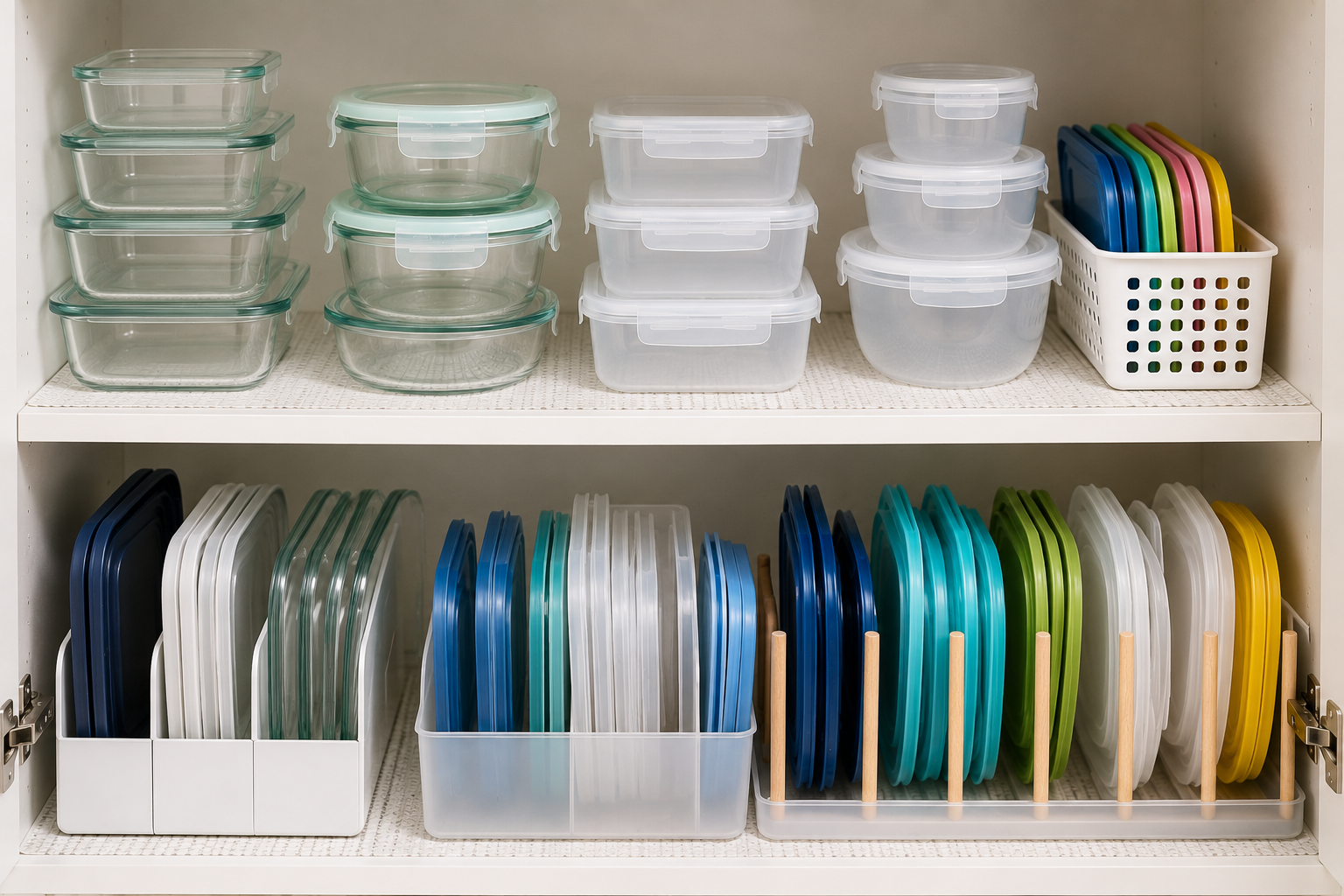
Organising containers by size is a simple method to enhance accessibility. Consolidate items of comparable dimensions to facilitate prompt retrieval. Utilising large containers at the base and smaller ones atop frequently proves effective due to their stability and accessibility. Logical arrangement of containers prevents the need to sift through clutter and disturbs the entire cabinet less. This approach transforms a vexing search into a swift, seamless endeavour.
Disaggregating Lids to Avert Disorder
Lids typically represent the most difficult aspect of container organising. They are slender, slick, and challenging to arrange orderly. Maintaining their separation from containers is generally most effective. Organise lids vertically in a compact container or partition to ensure they remain visible and accessible. When lids are arranged vertically rather than being stacked horizontally, all options are immediately visible. This method conserves time and averts the chaotic lid avalanche frequently encountered by individuals.
Employing Basic Dividers and Containers for Organization
Expensive storage solutions are unnecessary for the organisation of food containers. Utilising basic boxes, baskets, or drawer dividers helps establish organisation within cabinets. These tools prevent stacks from toppling and assist in preserving organisation over time. When each category possesses its own designated space, goods inherently remain organised. Organisation is simplified due to the establishment of distinct boundaries. Repurposed shipping boxes can serve this purpose effectively.
Establishing Daily Routines That Maintain System Functionality
The key to enduring structure is consistency. Following the cleaning of containers, align the lids and promptly restore them to their assigned locations. Refrain from indiscriminately placing containers in the cabinet without prior organisation. Minor regular practices inhibit the accumulation of clutter. Investing a few moments in preserving order prevents the necessity of redoing the entire organisation process subsequently. With time, these routines become instinctive and ensure the efficient operation of your kitchen.
Modifying Your System in Response to Evolving Requirements
Your container requirements may change over time. You may commence regular meal preparation or increase the frequency of packing lunches. Regularly assessing your storage arrangement ensures its continued suitability for your lifestyle. Organisation is not synonymous with perfection; rather, it embodies adaptability. Implementing minor modifications as necessary ensures your system remains functional and pragmatic for years ahead.
Final Assessment
Arranging food containers and lids may appear to be a little activity, although it significantly influences daily kitchen operations. Initiating a comprehensive reset, aligning lids, minimising surplus, establishing a designated storage area, and cultivating straightforward habits can convert a disordered cabinet into an efficient system. Preparing and preserving leftovers becomes more efficient, simpler, and significantly less burdensome. With minimal work and consistency, your container cabinet can transform into one of the most organised areas in your kitchen.
Frequently Asked Questions
1. What is the optimal number of food containers to retain?
Retain just items that you utilise consistently within a standard week. For the majority of households, a compact, manageable collection suffices.
2. Should lids be stored independently from containers?
Indeed, organising lids vertically in a designated compartment enhances accessibility and mitigates disarray.
3. What is the recommended frequency for reorganising my container cabinet?
A periodic examination every few months facilitates the maintenance of organisation and the elimination of broken or superfluous containers.
4. What is the most effective method to avoid misplacing lids?
Consistently pair lids with their corresponding containers post-washing and promptly return them to their assigned storage location.
5. Is it feasible for small kitchens to maintain long-term organisation?
Indeed. Regular daily routines and occasional tidying maintain the functionality and orderliness of compact kitchen areas.

Hannah is a home and kitchen writer who focuses on practical cooking, meal prep, food storage, appliance care, and everyday kitchen organization. She enjoys sharing realistic tips that help make busy home routines feel simpler and less stressful. Through experience-based articles and easy-to-follow advice, Hannah aims to help readers save time, reduce food waste, organize their kitchens more efficiently, and feel more confident managing daily cooking and household tasks.